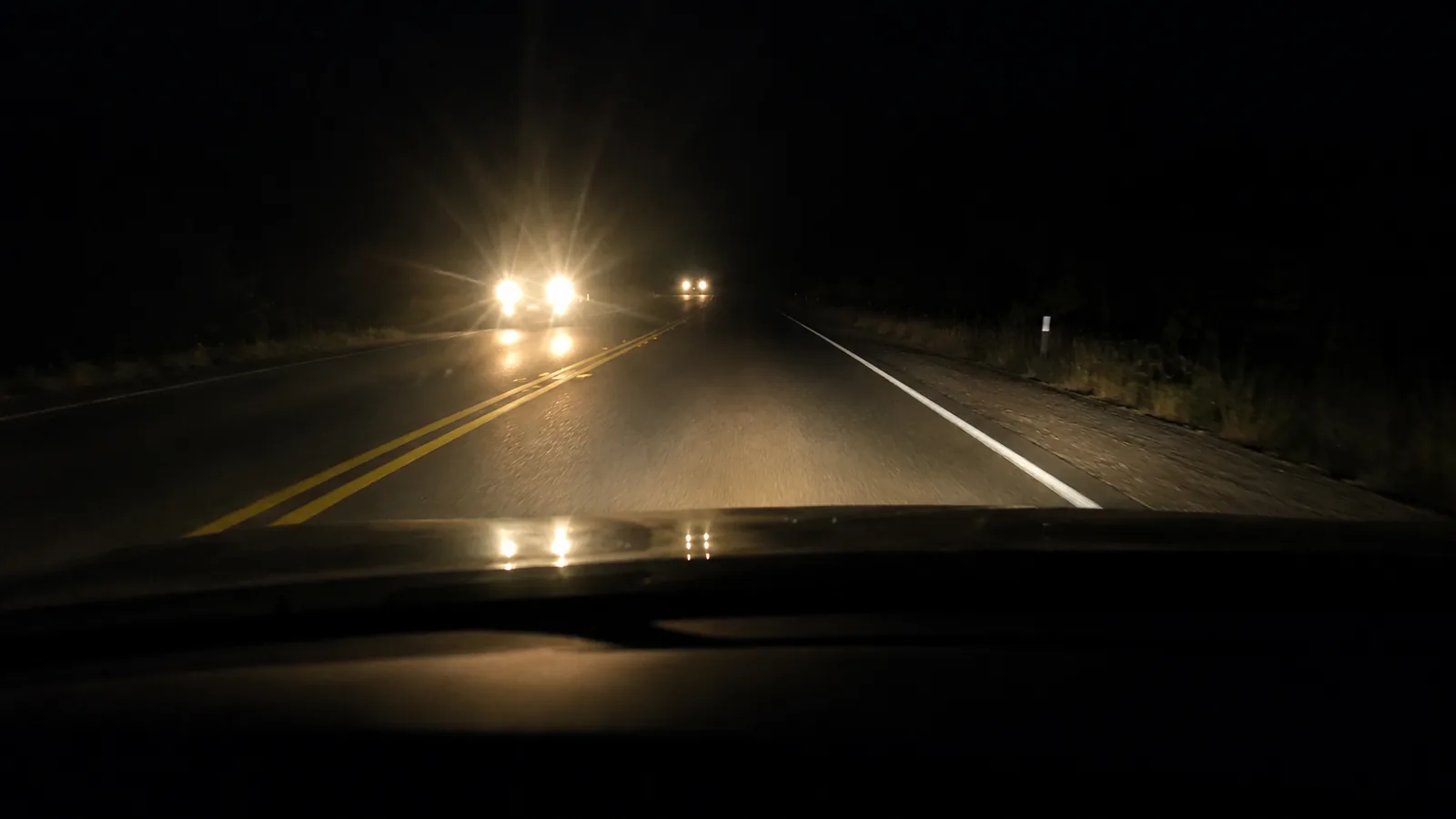
I no longer manage the headlights on my car. I have not touched the headlight switches in years. Yet, the design of the machine was sufficient in keeping me and others on the road, safe.
My car does three things I used to do, sometimes badly. It turns the lights on when it gets dark. It dims my brights so I do not blind the person coming the other way. And it keeps a light on in broad daylight so that person can see me.
That is the end of a long story, and the story is about how good design is the way compliance actually gets kept, without feeling like a barrier to getting where you are going.
The brights: better manners than I had that night
Dimming your high beams for oncoming traffic is a courtesy, and in California it is the law: Vehicle Code 24409 says low beams within 500 feet of an oncoming car. It is also something drivers get wrong constantly, because it depends on noticing a car and making a quick decision while enduring high cognitive load, or in other words, forgetting.
I have driven Highway 152 east out of Gilroy hundreds of times, over Pacheco Pass toward the Central Valley. At night it is a lousy road: undivided, dark, and full of curves, the kind where you want your brights on whenever nobody else is around. Late one night I had them on, the traffic came back, and I forgot. I drove the better part of a mile with my high beams in oncoming drivers' eyes while they flashed me, one after another, and I wondered why so many people were flashing their lights at me.
My human aptitude for fallibility did not increase the safety of the road that evening.
I have been on the other end of it too. You are driving along at night without a problem, and suddenly a car comes around a corner with its brights up, and for a few seconds you can't see the road. Same mistake, different seat. Responsibility on the road runs both ways: every driver is sometimes the one who forgets and sometimes the one who gets blinded, and on any given night the antagonist might be you.

In 1952, General Motors put a phototube in a little gunsight housing on top of the dashboard of Cadillacs and Oldsmobiles and called it the Autronic Eye. It watched for oncoming headlights and dropped your high beams for you, then brought them back once the other car had passed. It would have had better manners than I had that night.
And it did not take the driver out of it. A foot switch let you overrule the eye, and GM's own engineer listed that override among the system's requirements. A human in the loop, per se. Hmmm.
Technology adoption tends to repeat the same human learning curve: we hand the machine the job, but we keep a foot on the override until it earns our trust. We are doing exactly that with AI right now.
Notice the order of this high-beam evolution. The rule came first: dimming was already a duty police enforced, and GM's own engineer called it hopeless to get drivers to comply "either through education or law enforcement." Nobody required the equipment. It was sold as a luxury convenience feature on an expensive car, and it was designed to make compliance effortless to keep.
It was also not even close to perfect. It flickered at street lamps, reflective signs set it off, and curves confused it entirely. Picture a 1955 Cadillac rolling up to a reflective stop sign and having a small nervous breakdown in front of everybody. The first version of automated judgment is usually bad at the edges. But the design intent was good.
Maybe now this starts sounding familiar to AI adoption for real estate, with tentacles for both businesses and clients.
Lights on, and the rules for everyone else
The car turning its own headlights on is ordinary now. It started as a luxury option too, and the people who have it would not give it up. California has an additional rule it quietly satisfies: if you need your wipers, you need your headlights. On many newer cars, once the wipers are running, the headlights turn on automatically. But that convenience is not a law itself, and there's still people who forget or don't know the rule and drive in the rain without their headlights on, sigh.
Equipment never arrives everywhere at once. A rule has to cover every car on the road, including the twenty-year-old pickup, so the rule is written for the driver. The equipment is how a new car stops bothering the user and handles it for them, often with superior performance as the tech improves.
Here in California, we put up signs. The two-lane stretch of Highway 152 heading east out of Gilroy, the same road, has one. Headlights on, all day, for its own reasons: blind curves, no divider, and fog that settles in under certain weather. At night, brights work best when traffic is light, but only until someone appears. By day, the sign wants headlights on even in sunshine, and the CHP has said daytime running lights satisfy it. A car that has both pieces of equipment handles both scenarios without being asked, doesn't let the driver forget, and makes it safer for the driver and the oncoming car alike.
The signs are not a failure. The signs are for the cars that can't do it themselves.

Which means there are always two ways to comply. Remember the sign, every time. Or drive the product that already has it handled.
The turn
Every rule about human conduct is a bet that a person will remember it at the worst possible moment. GM's own research engineer said it in the opening of a 1953 paper on the Autronic Eye: "It has not been possible to get drivers to use their beams properly." That is not a complaint about drivers. It is a design brief.
So you get a choice about where to put an obligation: on the human, or in the equipment. The second one is not a loophole. It is the same duty, honored more reliably, by something that is never tired and never in a hurry.
And here is the claim I actually want to make, because I think the industry has it backwards: convenience and compliance are not opposing forces, and compliance does not have to feel like a barrier to doing business. We talk as though every safeguard is a tax on the experience and every good experience is a corner cut. The headlights say otherwise. The compliant version and the nicer version turned out to be the same version. Compliance became necessary, and out of that grew the demand for a convenient way to comply.
The objection is always but that requires judgment. My car makes that judgment a few thousand times a drive, better than I could. And Rocalyn has already watched it happen in our own product. Our system has flagged possible fair-housing problems in listing descriptions that came straight from the MLS. A person wrote those lines, and they went into the MLS without anyone stopping them. The machine was the one that noticed.
We do not treat that as a wall. The listing is the agent's, and so is the call. But the design makes moving forward a human decision: to keep flagged text, somebody has to say why, and that decision is recorded. The equipment raises the question. A human answers it. GM got that order right in 1952: the eye did the dimming, and the foot switch stayed under the driver's foot.
The job
There's an old idea in product design called jobs to be done, most associated with the late Clayton Christensen: people don't buy products, they hire them to do a job.
Nobody hired the Autronic Eye to comply with anything. The job was getting home safely at night, on roads full of other drivers getting their headlights wrong. A realtor's job has the same shape: answer the client's needs and get them the transaction they want, while protecting your license and the duties that come with it. That isn't two jobs. It's one, and a tool that does half of it hasn't done the job.
Now the real estate part I actually care about
In March of 2026, the California Department of Real Estate published an advisory on artificial intelligence in real estate. Its message: using AI for licensed work is like handing it to an unlicensed assistant, and if an AI tool gets it wrong with a consumer, responsibility under current law "rests with the licensee and their responsible broker, not the technology provider."
Read that twice. The license on the line is yours. Your vendor does not have one.
That is not a complaint about regulators. It is the same arrangement as the road. When the ticket gets written, it goes to the driver, not to the automaker, and automatic high beams never changed that. What the equipment did was make failing at it a product choice.
The advisory is the sign on the side of the road. It applies to every licensee using every AI tool, the free chatbot and the expensive one alike. You can comply by remembering, on every call, what the tool must not say. Or you can drive the car that has the headlights on. Our fair housing guide asks where the discipline lives. Does it live in the product, or does the product say nothing about it?
What a compliance consultant noticed
Summer Goralik, a former DRE investigator who now consults on compliance, put the line where I would. In August she wrote about a brokerage chatbot that, asked what to offer on a stale listing, named a number below asking. Disclosing that it was an AI would not have fixed it. Her rule is six words long: "Just don't let it become the agent."
And this is where the brights come back around. Two cars on an undivided road only have to worry about each other while they pass. Before that moment, each owes the other low beams; after it, both are free to drive however they like. A real estate deal is the same intersection: buyer and seller meet in the middle, and once the transaction closes, neither has to think about the other again. The safety part is the engagement leading up to that moment, every call and every answer along the way.
One day you represent the buyer. The next day, the seller. The bot that talked a buyer below asking on somebody else's listing is the same kind of bot that will do it on yours. Reciprocity of shortcuts is a thing.
In September she came back to a term of hers, reverse compliance: learning what compliance required only after the complaint, the investigation, or the lawsuit. Her alternative is to "build meaningful guardrails before a regulator or plaintiff's attorney identifies the problem for you."
On the road, reverse compliance is the ticket for driving in the rain without your headlights on. Unfortunately, it is how many people learn the wipers rule: from the officer, not the handbook. The Autronic Eye is the opposite: the rule already existed, and GM built the equipment that kept it for you, before the ticket.
Our job, as the people building the tools, is to ship the equipment version. I won't turn this into a product tour. In short, ours says it is an AI on every call, and it is designed to answer only from what the agent gave it and never to pretend to be you. The rest of what we deliberately don't build is on our trust page. The disclosure happens every time. For every other duty a licensee owes, we designed it to be strong, and like the Autronic Eye it can't be perfect. It also doesn't move the duty: that still rests with you, the licensee, exactly as the DRE says.
What this does not settle
None of this tells you exactly where the line sits. It tells you that a line can be built into the equipment once somebody draws it. How specific may a property answer get before it becomes advice? Is describing a fact the same as interpreting it? I do not think any vendor gets to answer those alone, and I am suspicious of the ones who sound certain.
So was 1953. That GM paper listed fourteen requirements an automatic dimmer had to meet, including: dim for cars on curves, and not for stray light at the roadside. It concluded the Autronic Eye met all fourteen. The drivers of GM's Futurliner show trucks remembered every streetlight setting it off. The difference between the 1952 version and the one in my car is not that somebody got it right the first time. It is that somebody kept working on the same problem for seventy years.
The rules are still arriving, too. We keep a guide to what the states actually say about AI in real estate and re-verify it every quarter: AI and fair housing. I last checked it October 1, 2026.
The takeaway
The rules of the road are expected to be followed at dusk, in the rain, with a client on the other line. How you follow them is a product choice. Good design is how compliance gets kept, and when it is done well it does not feel like a barrier at all. The Autronic Eye was sold as a nicer way to drive at night, and keeping the rule got a lot easier.
Goralik calls vigilance an advantage. I would go one step further: once it is built into the equipment, it stops feeling like vigilance at all. Equipment is the opposite of reverse compliance.
The Autronic Eye cost extra. Equipment always does. What you are paying for is a product that anticipates the whole job, the rules included. That is the bet we are making with Rocalyn Edge: choosing a product that anticipates your needs, so you are not micromanaging your headlights, is worth the premium.
I think the line Goralik is asking regulators to draw is drawable. I would like to talk about where it sits, with her and with anyone else who has been thinking about it seriously.
Sources
For anyone who wants to check my work, here is where everything above comes from.
The Autronic Eye
- G. W. Onksen, General Motors, "Development of the Guide 'Autronic Eye,'" Highway Research Board Bulletin 68 (1953), pp. 31-39: the "drivers won't use their beams properly" line, the driver override requirement, and the fourteen requirements. Record · PDF
- Oldsmobile 98, 1952 model year: the Autronic Eye's debut on Oldsmobile and Cadillac. Wikipedia
- John Oldenburg's restoration notes, GM Futurliner Restoration Project: the foot switch, and what the Futurliner drivers remembered about streetlights, signs and curves. Archived page
- Automatic headlights as a luxury option: GM's Twilight Sentinel, Wikipedia, "Headlamp," section "Automatic headlamps." Wikipedia
The rules
- California Vehicle Code § 24409: low beams within 500 feet of an oncoming vehicle. Statute
- California Vehicle Code § 24400: lighted headlamps when wipers are in continuous use. Statute
- Caltrans, California MUTCD sign cross-reference: the S30-1(CA) "Daylight Headlight Section" sign. PDF
- Los Angeles Times, Ralph Vartabedian, "Daytime running lights are sufficient" (August 13, 2003): the CHP's position that daytime running lights satisfy posted daytime-headlight requirements. Article
- AARoads Wiki, "California State Route 152": headlights required at all times on the two-lane stretch east of Gilroy. Wiki
The job
- Clayton M. Christensen, Taddy Hall, Karen Dillon and David S. Duncan, "Know Your Customers' 'Jobs to Be Done,'" Harvard Business Review (September 2016). Article
The regulator and the compliance conversation
- California Department of Real Estate, Artificial Intelligence in California Real Estate (advisory, March 17, 2026). Advisory
- Summer Goralik, "Hey, chatbot: Who are you?" Compliance Never Sleeps (August 19, 2026). Post
- Summer Goralik, "The Upside Of AI Anxiety," Inman (September 2, 2026). Article
Ours
- Rocalyn Edge, AI and Fair Housing: what the states say about AI in real estate, re-verified quarterly. Guide