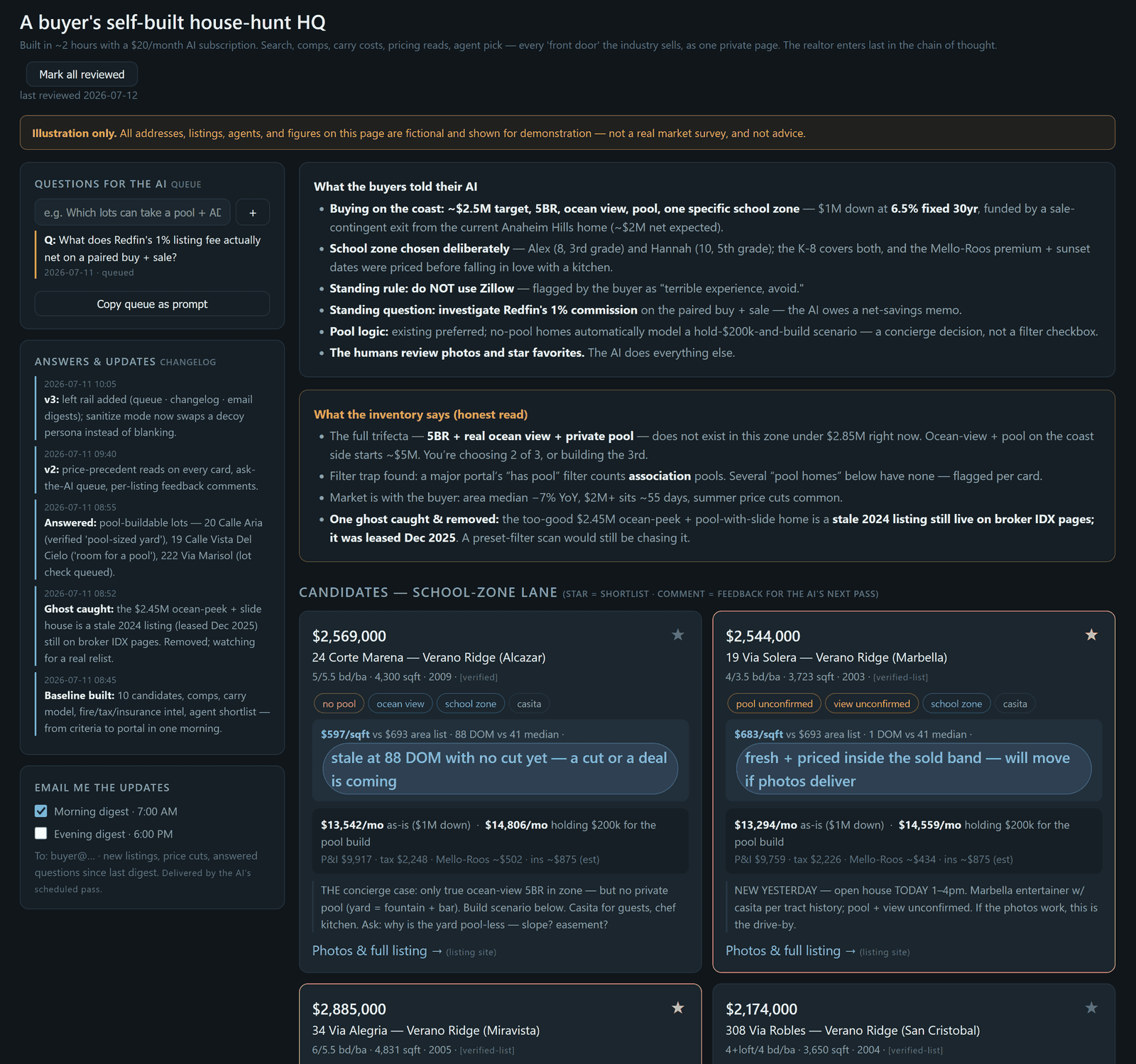
If you were becoming more expert at AI, wouldn’t you use it, plus an hour or two, to make a six-figure decision?
Your clients are answering that question right now. Not in a survey. In their browsers, on a Tuesday night, with the same twenty-dollar AI subscription they already use to plan trips and rewrite emails.
This week I answered it myself.
I handed an AI a real house hunt: a coastal move, a target near two and a half million, five bedrooms, an ocean view, a private pool, a specific school attendance zone. In 15 minutes I had the first mold and layout, and then I continued tweaking it while I was distracted by a World Cup game. About two hours later I had a web page nobody sold me. My zip codes sat in the sidebar with live counts of matching homes. The school zone was pinned, with the houses inside that attendance boundary flagged. Every saved listing carried the recent solds around it, price per square foot, days on market. My pre-approval drove a scenario table: twenty percent down on the as-is house, or fifteen percent down plus a renovation budget, each with the monthly payment I would actually carry. At the bottom, a short list of local agents, ranked by reviews and volume, each with a phone number.
That page is not a product. It has one user. It will be thrown away at closing. It cost nothing beyond the subscription I already had.
Look at what it quietly replaced. The portal I was supposed to start on. The branded search site a brokerage pays for. The app with the push notifications. Every one of those products is a bid to own the buyer’s front door, and an entire industry of vendors sells them to agents on that promise. I printed my own front door in an evening.
And here is what the two hours actually taught me, the part a filter menu never will. The tools you trust lie in specific ways. A stale IDX page served me a seemingly perfect listing: right price, pool, slide, ocean peek. The house was not for sale. It had leased in December as a rental; the sale record was a stale 2024 listing the feed never retired, and a preset-filter scanner would still be chasing it. A “has pool” filter counted association pools as private ones: the badge said pool, the actual backyard was a fountain and a built-in bar. And the one that matters most, my exact wish list did not exist. Nothing on the market hit ocean view and private pool and five bedrooms and that school zone at once. A filter would have returned zero results and left me loosening boxes at random. The AI did what a filter cannot. It laid out the honest trade: the view without the pool, or the pool without the view, and then a third path no dropdown contains, buy the view, hold two hundred thousand back, and build the pool. That is judgment rendered in software, and it was sitting on my side of the table.
Before you file this under founder-who-can-code: a buyer near Yosemite recently had their AI build the same kind of page, configurable zip codes, a toured-versus-pass triage board, price-drop detection, days-on-market tracking, and then published the build spec so the next buyer’s AI can copy it in one paste (the repo is public). Fair calibration: the one professional engineer who documented a build like this end to end says a non-coder would still trip on the last deployment mile today (his write-up). True. Hold that thought, because that mile is exactly what’s shrinking.
Meanwhile the largest portal in the country read this correctly and moved. Zillow now runs natively inside ChatGPT, on the free tier. “Show me homes in 92104” is a sentence you say to your AI now, not a website you visit (Zillow’s announcement). When the biggest front door in the industry voluntarily becomes a feature inside the consumer’s AI, the argument about where the buyer journey starts is over. It starts in the chat window.
The part nobody at the conferences is pricing in
The industry’s working assumption, and you can hear it on every main stage this season, is that most buyers and sellers are still old-school. They need to be led from step one. So the strategy is to out-produce each other on information: more data, more content, more platform, a bigger funnel mouth.
I think that has it backwards, and we have seen this movie. Walking onto a car lot used to be the whole shopping experience, and everyone knew which step was the swindle. Today the sales floor is the last stop. The buyer arrives knowing the invoice price, the trims, the colors, and every matching car within two hundred miles. Information did not kill car salespeople. It moved them to the end of the process and changed what they are paid to do.
Real estate is earlier on the same curve, with a steeper slope, because this time the buyer is not just reading more. She is compiling. Preferences, dislikes, regions, financing constraints, the kitchen she keeps screenshotting. That context used to evaporate across forty browser tabs. Now it accumulates in one place, and her AI acts on all of it at once.
The clock-speed problem
Here is the uncomfortable arithmetic. A typical buyer spends a median of ten weeks actively searching before going under contract (NAR’s most recent Profile of Home Buyers and Sellers), and with escrow the door-to-close stretch still runs a few months. Now look at the other clock. In the eight weeks before I wrote this, every major lab shipped a materially better model: Anthropic released Opus 4.8 and then Sonnet 5, OpenAI previewed and then opened GPT-5.6, Google shipped Gemini 3.5 Flash. Run the two clocks side by side. Your client’s tools will upgrade two or three times inside a single transaction, silently, for twenty dollars a month, with no procurement cycle and no training rollout.
Your platform, meanwhile, arrived on a multi-year contract and improves when the vendor’s roadmap says so.
The client’s tools compound weekly. The professional’s tools compound annually. So the informed-client gap does not just exist, it widens while the deal is in escrow. And the deployment mile that still trips a non-coder today gets shorter with every one of those releases. The distance between “an engineer did this in three days” and “anyone does this in an afternoon” is not a question of if. It is a question of which escrow period it closes inside.
And you don’t think anyone will use that in their favor?
The filter question
One detail from that page deserves its own paragraph. It filtered on school zones, because a person can build whatever they want for themselves. A licensed professional has to handle those questions with care, and rightly so; fair housing law exists for good reasons and it governs what professionals steer, not what consumers privately prefer. But notice the asymmetry: the buyer’s own software freely sorts on the exact criteria the professional must decline to advise on. That is one more force pushing discovery to the client’s side of the table, and it is barely being discussed.
Who the AI could actually recommend
Then I asked the page’s last question out loud, the one every buyer now asks their AI: who should I call? So I let it shop for the agent the way a client will. What it hit was its own inversion. The review sites a human trusts first were closed to it. Zillow returned a 403. Yelp returned a 403. One “top agents” directory returned, with no irony, 402 Payment Required. The single tier that was fully readable, end to end, was the agents’ own websites, the ones who had published their stats, their neighborhood guides, their sold history on a domain the AI could read. A consumer’s trust stack runs reviews first and the agent’s own marketing last. For the AI it is exactly backwards. The agents who publish are the agents who get found. The quiet great ones with a profile on a walled platform and nothing of their own were invisible, however good they are.
What doesn’t get vibe-coded
If this reads like doom, look again at the bottom of that page. The last element on it is a list of professionals and a call button.
An afternoon of AI can build a search page. It cannot hold a license, owe a fiduciary duty, get the keys, read a seller’s agent across a kitchen table, structure an offer for this specific market this specific week, or carry the liability when something goes wrong. Judgment, access, negotiation, and accountability survive. Everything whose main job was information delivery is negotiable now, including a lot of software your industry is currently being sold.
So here is where it lands, and it is not a warning. The tools that let a buyer skip the used-car-salesman step are within reach today, for the price of a streaming subscription. That is good news, because it retires the part of this job nobody was ever proud of. What it leaves standing is the whole point: reputable customer service and professional execution, the actual work of closing a deal well. The buyer builds the search. You earn the call, answer it like it matters, and close it like a professional. That was always the job worth having.
The questions I would ask, in any room where the next wave of real estate technology is being planned:
What is your buyer’s shopping window, and how many model upgrades ship inside it?
If your client arrives at the last step already compiled, compared, and pre-approved, what exactly is your first-step funnel for?
And when the call button on her home-built page gets tapped at 9:41pm on a Tuesday night, who answers, and are they worth the tap?
Part of a series on what doesn’t survive contact with an informed client. Dave Selinger is the founder of Rocalyn, building Rocalyn Edge, an AI answering service for real estate. It answers the phone so agents can be the humans in the room.